
The MIT Press, 2026.
This is an online program — virtual only.
In his online talk, "The Origin of High-Rise Construction and Why You've Never Heard About It," historian Gregory Dreicer will explore how nineteenth-century builders industrialized the building process. Although this transformation included the development of the long-span beam, truss structures, and high-rise construction, historians have not told us about it. Dreicer explains why, by asking simple questions—“What is a wooden bridge?”—as he challenges the narratives that shape the past and future of our designed environments.
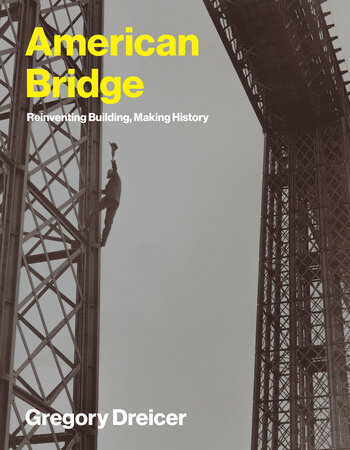
In his new book American Bridge: Reinventing Building, Making History, Dreicer explores a radical reimagining, a new way of building that introduced uniformity and modularity on a global scale while enabling the connectivity essential to the rise of the nation-state. With tales of bygone infrastructure and astonishing images, Dreicer spans a deep gap in history by tracking the transnational creative flows that propelled the development of beam, truss, and skeleton frame as industrial essentials, shaped by classical, capitalist, techno-utopian beliefs that still animate engineering and architecture.
To register for this FREE program, click on the link above to RSVP. You will be redirected to Ticketstripe to reserve your seat. The Zoom room is limited to 100 people. If you can't enter the Zoom, you can watch the program live on our YouTube channel when it begins at 6pm. Members receive priority registration by emailing [email protected] with the names of all guests. Want to become member? Click here!
Gregory Dreicer
Gregory Dreicer is a curatorial strategist, experience designer, and interdisciplinary historian who develops projects that engage the public in explorations of narrative, place, and identity. He holds an M.S. in Historic Preservation and a B.A. from Columbia University and a Ph.D. in Science and Technology Studies from Cornell University. He was a fellow at the Smithsonian Lemelson Center for the Study of Invention and Innovation, a Loeb Fellow at the Harvard University Graduate School of Design, and a Fellow at the Cullman Center for Scholars and Writers at New York Public Library.